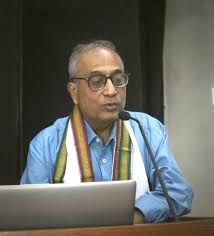
Professor Irfan Habib
Irfan Habib is a leading historian of medieval and early modern South Asia, best known for his influential use of Marxist historiography to analyze economic and social structures. His work stresses on material conditions, class relations, and modes of production in history.
A defining feature of Habib’s scholarship is his rigorous engagement with primary sources, Persian chronicles, Braj documents, administrative documents, and revenue records from the Mughal period. Through careful textual analysis and theoretical framing, he reconstructs the institutional and socio-economic foundations of Indian history. His research places particular emphasis on agrarian relations, examining land tenure systems, revenue extraction, and the interactions between peasants, zamindars, and the state.
Habib’s studies of the Mughal agrarian system have been especially influential in reshaping understandings of rural society and state power. He highlights the mechanisms of surplus appropriation and the tensions embedded within imperial structures, challenging earlier interpretations that portrayed the economy as static or harmonious.
Habib has also contributed to the study of technology, environment, and economic practices in pre-colonial India. His work explores themes such as irrigation, agricultural production, and artisanal activity, demonstrating the close link of technological developments with social and economic contexts. This interdisciplinary approach has expanded the scope of historical inquiry in the field.
In historiographical debates, Habib contributions particularly critique communal and sectarian interpretations of history. He advocates for evidence-based approach that is grounded in critical analysis. His scholarship has had a lasting impact on the study of Indian history and continues to shape methodological and interpretive dimensions within the discipline.